Anatomy of a Plastic Bottle
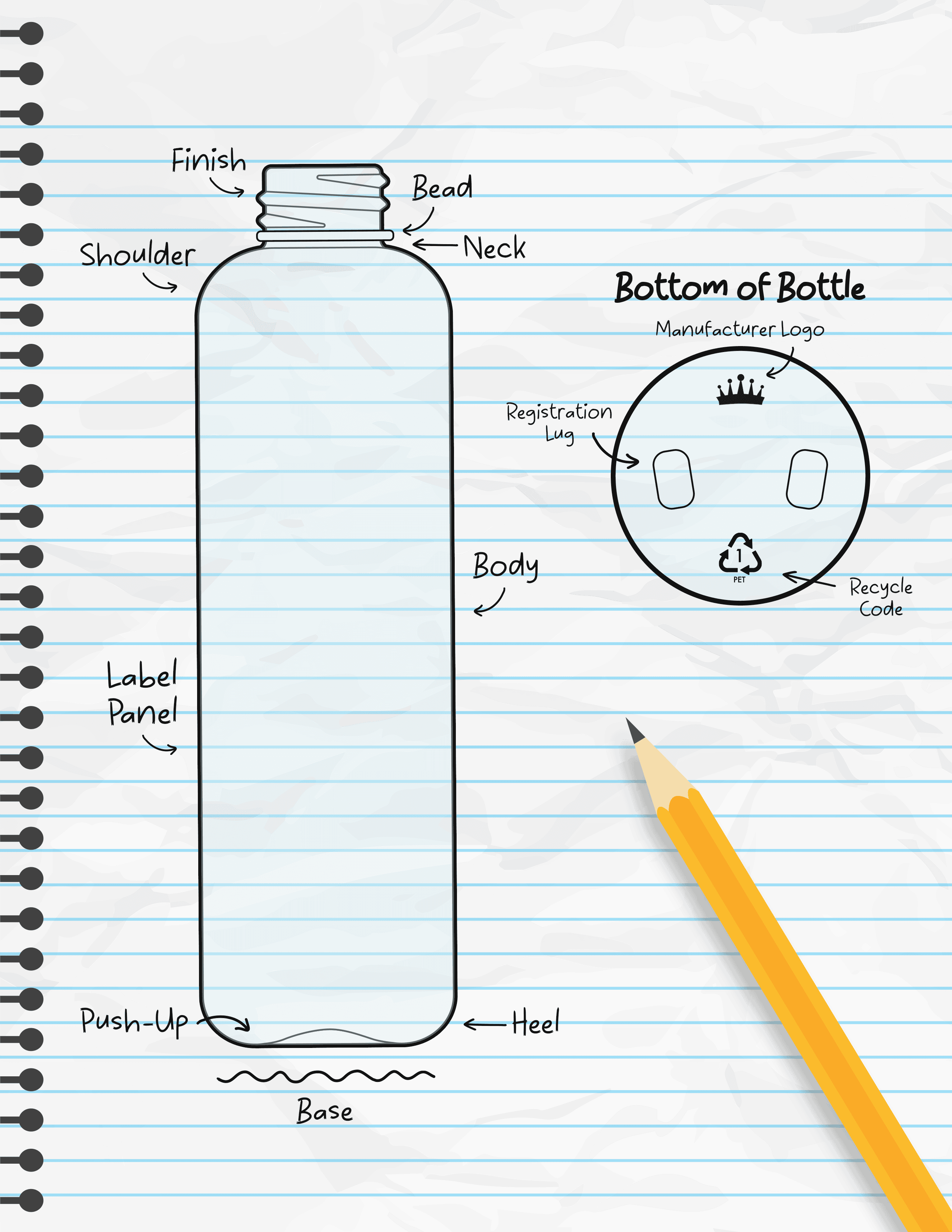
| Finish |
The plastic that forms the opening of a container and is shaped to accommodate a specific closure. |
| Bead |
Also known as a transfer bead, it provides a surface by which the preform is suspended while it is reheated and blown into a bottle. |
| Neck |
The constricted part of a bottle that lies above the shoulder and below the finish. |
| Shoulder |
The part of a container between the main body and the neck which is usually sloped. |
| Body |
The principal part of a container, usually the largest and widest part of the bottle. |
| Label Panel |
The area of a container, usually the largest and widest part of the bottle. |
| Heel |
The part of the bottle where the body begins to curve into the base. |
| Base |
The very bottom of the container which includes the PUSH-UP. The PUSH-UP is the concave region that provides stability. The base is often marked with a recycling code and deco lugs or registration features which are used to orient a bottle during filling and labeling. |
| Did you know? The term finish references the original mouth-blowing process of making glass bottles where the final step was to finish the lip. |
Another term from the early days of glass blowing is the PUSH-UP. When forming the bottle, the glass blower would physically PUSH-UP in the center of the base using a tool. |


E.J. McKernan Co. © 2026. All rights reserved.